How to resolve AdBlock issue?

Brian Sandalls of TurfCareBlog writes . . .
I will just outline some possible tasks that will help you prepare your cricket facilities for the onset of a new playing season. However, bare in mid each and every cricket club ground will have its own unique requirements, depending on topography, soil make up ground conditions and resources.
Cleaning up of the surfaces
If you have access to a mower/verticutter or brush cassette with a grass box, then a few light passes over the square would be ideal. This will clean up the square of debris, such as rabbit droppings, small twigs and dead leaves from the grass surface.
If you don’t have access to a brush/verticut cassette, a rotary mower would also act well in the surface clean up, ahead of pre-season rolling.
Verticutting can also take place on a bi-weekly schedule, once grass growth is actively growing.
Height of cut
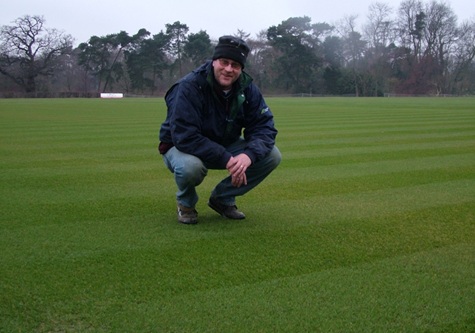
Over the coming weeks, we need to start/continue to reduce the HOC (height of cut) of the square to around 12-15mm by the start of the first match, so no hurry.
Personally, l like to go down to 12mm at the start of the season and raise up as the grass gets stressed during hot periods. The aim is not to stress the plant too much by removing no more than a third of the leaf in any one cut and take it down gently over the weeks to a HOC that suits your square and preference.
Nutrition
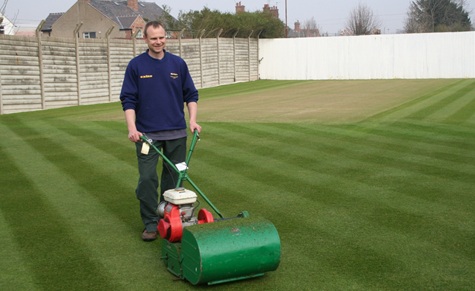
I ideally like to get a feed on prior to pre-season rolling as this can be quite a stressful time for the grass plant. It is common to feed with around 4-8% (nitrogen) why growth is slow, prior to going onto a Spring/Summer fertiliser with higher nitrogen levels in March/April to match increased growth or and after pre-season rolling.
Just avoid feeding the wicket/s you are planning on cutting out first, if you’re nearing your cut out time. Also ensure granular is fully washed prior to pre-season rolling, if so delay until after, as this will prevent the roller from crushing the prill and possibly scorching the grass plants leaf blades.
If overseeding large areas, a feed containing phosphorus will help with root development.
Avoid any applications containing a percentage of Fe (iron) if you have any newly established grass plants, as an application of iron to a young grass plant when at the one leaf stage could damage the leaf.
If you’re not needing to overseed or can treat prior, then you can consider the application of an iron-based product for the treatment of moss if you have any. I would also recommend over winter a fertiliser that contains an element of Fe, as this helps keep any moss in check.
Any doubts, read the instructions on the bag and speak to those who supply your fertiliser, for advice on the correct product in your circumstances.
Stock and sundries
Get your stock and sundries (fertiliser / seed) in well before you need them and store in a dry location, you can then act quickly in response to application windows etc.
Overseeding - before or after pre-season rolling
Always a tricky one around times of pre-season rolling, l have found that pre-season rolling is carried out over several weeks or weekends especially for the recreations groundstaff and this also allows time for the soil to dry out between rolls /weights.
There are also natural breaks in the weather, which will create a natural opportunity to get some overseeding done. I look to get any seeding done towards the final stages of pre-season rolling. I do this to ensure the seed gets rolled into the surface nicely to create seed/soil contact but also doesn’t have enough time to germinate and establish and be rolled to death by the roller.
Overseeding timing
This can be very dependent on where you are based in the country, but once you’re cutting grass and it’s growing with average temperatures over/above 10°C or even a bit lower the seed will germinate.
Heavy frosts can damage young grass plants, horticulture fleece or germination sheets can be of help, but ideally you would wait till late march into April once the worst of the frosts have passed (location depending).
Seeding depths
Perennial Ryegrass grass seed requires good seed/soil contact, this can be achieved by means of creating shallow holes via a sarel roller, grooves, anything to get the seed 10-15mm into the soil surface.
Square up the square and identify pitch positions
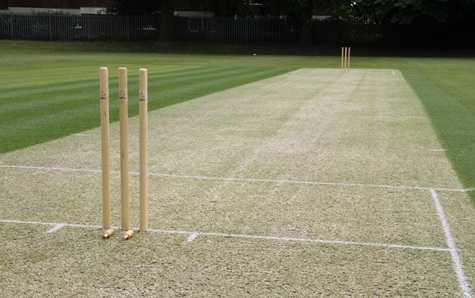
Ensuring the square is squared up is pretty vital to ensuring all wickets are equal in length (66 ft adult) and width and all the popping creases line up and look right with the use of Pythagorean theorem.
I’d get the corners in pre-season rolling and then put the pitch positions, every 10 ft once pre-season rolling has finished, this will ensure the marks don’t get moved about in the nap of the grass by the heavy roller.
Please see this blog on squaring up the square: How to Square up a Cricket Square-Step by Step.
This can be done once you have all your fixtures in place, the ideal is to alternate pitch positions in odd numbers, so pitch 2 then, 4, 6 and once you’re at the end of the square say it’s 8, then fill in the gaps, so 3, 5, 7.
In reality, this doesn’t always work out but it’s a good starting point to the planning process. This is a challenge for clubs where the first team insists on using only the middle pitches.
My own pitch plan starts with the priority fixtures, ensuring these fixtures are played on middle tracks and then l work the rest around these dates.
Pre-season rolling
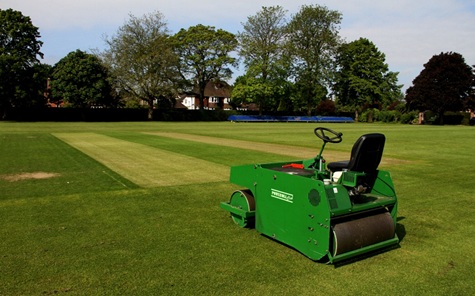
Pre-season rolling in April when the soil is drying fast, can mean it being less effective so whatever the start date of the season, l would still recommend a March-onwards programme of pre-season rolling, but only in the correct conditions as it’s better to do nothing, than do something in the wrong conditions.
Please don’t get confused with there being enough moisture in the soil and the soil being wet. We cannot compact water, we can only manipulate the soil into the air spaces in the soil and this can only be done when the soil is moist, not wet.
If the soil when rolling, caps, seals, smears, ridges or buries grass it is too wet. If so, just go and put the kettle on and return at a more suitable time.
Ideally the grass plant also needs to be growing at the time of pre-season rolling, so the roots can extract out moisture to gently dry the soil where surface evaporation doesn’t reach.
Whatever you do take your time, know what you’re trying to achieve, trust your gut and knowledge of your site, weather patterns, locations, resources all factor into what is possible. As l said it’s better it’s better to do nothing, than do something in the wrong conditions.
If you get behind, your get back on track, enjoy the process and work with the ground conditions you have, even if that differs to the grounds team down the road.
Editorial Address:
LandPower Publications LLP, Howbery Park, Benson Lane, Wallingford, Oxfordshire, OX10 8BA
Telephone:
Steve Gibbs: +44 (0)7929 438213