How to resolve AdBlock issue?
TurfPro editor, Laurence Gale, writes . . .
Recently I took the opportunity to catch up with Gary Whitney, owner of Smartlawns Ltd, who invited me along to see how well his robot mowers are working at Leamington Spa Golf & Country Club.
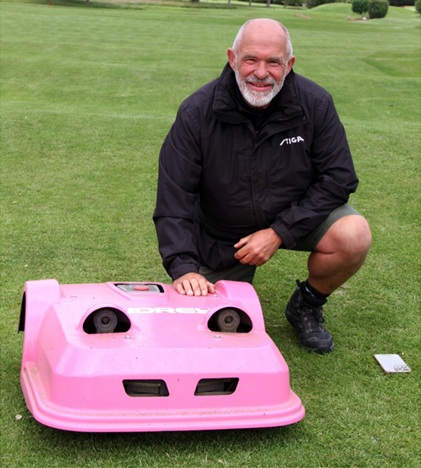
Gary spent 23 years working for STIGA in the UK starting in sales and had the great honour of being the UK managing director from 2018 until September 2023.
In 2024 he decided to retire from his role but stay involved in our industry by setting up Smartlawns - a service Gary could see as a great new business opportunity that enabled him to utilise his vast skills and experiences to promote the use of robotic lawn mowers to maintain lawns and professional sports surfaces.
Essentially the service evolves around giving advice on lawn management and choosing the right robotic appliances to deliver the expectations of the customer. The company's offering centres on helping customers move from conventional mowing to autonomous lawn maintenance.
Gary will then conduct a site survey and lawn assessment - evaluating the lawn's size, shape, slopes, access points, and any obstacles before recommending a robotic solution. He will initiate a professional installation, installing the charging station, configuring the mowing area (whether using boundary wire or wire-free technology, depending on the mower), and commissioning the system.
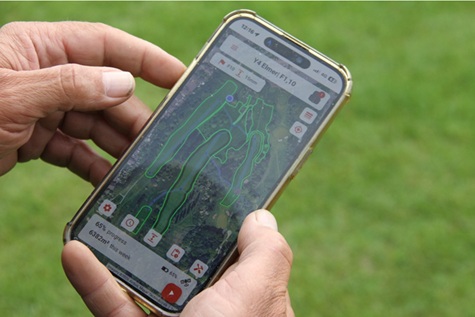
Gary will, with the customer, set up the programming and optimisation of the robots setting cutting schedules, mowing zones, cutting heights, and smart app controls so the mower operates automatically with minimal owner involvement.
He then offers an ongoing servicing and maintenance schedule that includes regular inspections, blade changes, software updates, troubleshooting, and seasonal servicing and repairs.
The operating philosophy is quite different from a traditional lawn mowing contractor. Instead of visiting weekly to cut the grass, the robot mows little and often - typically several times per week or even daily. This produces finer clippings that decompose into the turf, helping maintain a consistently short, healthy lawn without collecting grass cuttings.
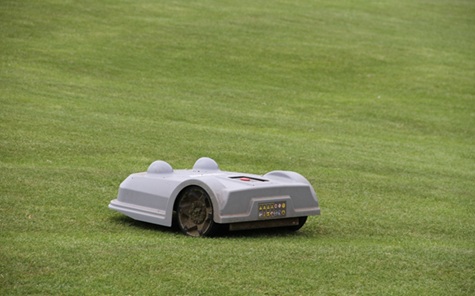
Gary has a demo ground where he currently employs several robot mowers, working on different size lawns and large open space areas. He has even got one robotic mower operating inside a glass house orchard. These robots have been operating for a couple of years now and the results are quite staggering. Gary can invite customers to see the different types of robots working and the quality of cutting achieved. The site allows customers to see the potential of what robotic mowers can achieve.
Part of his service to golf clubs, sports fields and domestic customers is to install one of his demonstration units for a reasonable trial period, this can be up to 2 to 3 weeks for large applications like golf or just for 24hrs in a domestic lawn application, the robot becomes his silent salesman.
The net result has been several golf courses have shown interest, with one committing to buying four robots to help maintain the course.
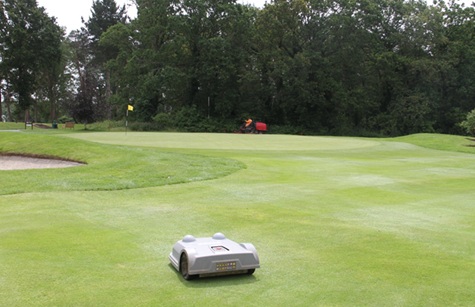
Leamington & County Golf Club
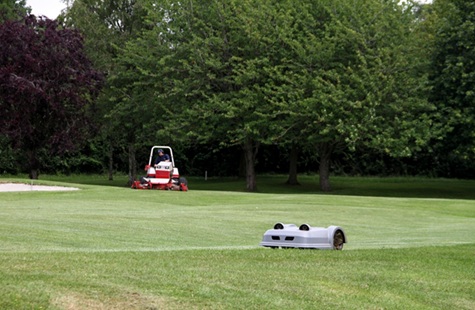
Gary was keen for me to see how well his robots were working at a busy Midlands golf course. After speaking to the head greenkeeper and golf director we had permission to come and visit the robots working at the Leamington & County Golf Club an 18-hole parkland course with soil pushed up greens and on clay soils, essentially a grass factory. With only a team of four staff it was a no brainer to look at the potential of using robots to help maintain certain parts of the course, namely, fairways, rough and approaches, to easy the workload.
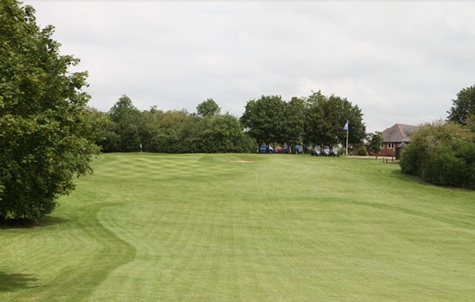
On the day of my visit, I was introduced to Bryan Frazer the golf course’s general manager who has been at the club ten plus years and was responsible for instigating the provision of the robotic mowers. Bryan, an astute businessman, weighed up the benefits and costs of investing in several robots compared with the cost of conventional fairway mowers. After having a demonstration of them via Gary, he soon came to the decision of the benefits they would bring in helping maintaining the course and freeing up the staff to do other priority works.
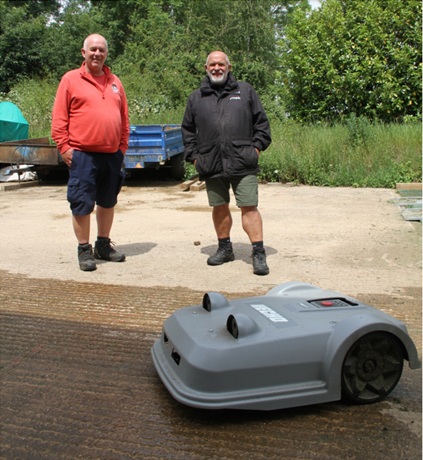
I also met Jason Cooper, the club’s head greenkeeper, who been with them some 26 years having joined the club in 2000. In that time, he has built up a strong but small greenkeeping team who over the years have done a lot of work to improve the course.
With such a small team the emphasis is on buying the right maintenance equipment to be efficient. They are constantly building up a decent maintenance fleet that includes Toro mowing equipment, the now popular range of Ventrac equipment, Sisis scarifyers and seeders and of course most recently the five Echo TM 850 robotic mowers.
Leamington Golf club purchased 5 Echo robots with a total investment being less than 50K including the site-based antenna with a range of 15 km, that can be used to serve an expansion in the number of robots that they have as well as installation and training.
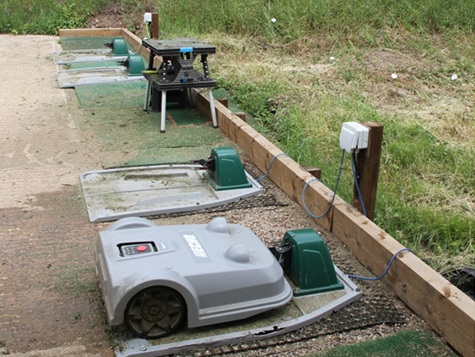
Bryan stated that the cost-saving potential over 10 years is significant, with robots outperforming conventional mowers in terms of maintenance and fuel costs. Also, it is becoming increasingly difficult to recruit staff. So, taking all these things into consideration the investment in robots is now becoming a reality for many golf clubs.
Bryan and Jason enlisted the help of Gary to demo the robots. To help in setting them up to mow efficiently, they each have their own recharging stations.
The robots can be programmed to work in different areas of the course and once you have worked out the time it takes to cut a given area, allowing recharging times, it is then a case of making sure they are set up to provide the cutting regime required.
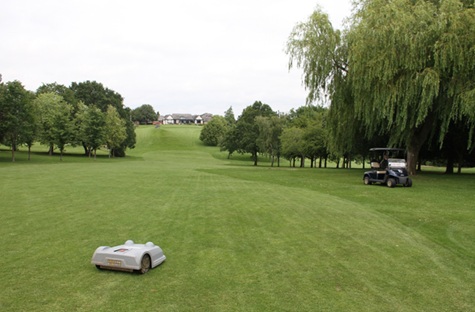
Effectively these robots are set up to cut the fairways and rough up to three times a week, but generally due to the recent hot weather they have found that robots are generally cutting fairways twice weekly at 15mm and the rough between 45 and 55 mm but these heights can be easily adjusted using the Echo Connect app or the laptop portal.
The robots comfortably manage the 80,000 sq meters of fairways that were initially mapped three times per week and subsequently Richard Biggs (deputy head greenkeeper) has been adding additional areas for the robots to manage like 'carries', 'semi-rough', 'rough', 'approaches & tees'. Currently as growth has slowed down, he has scheduled fairways at night and other areas that have less impact on golfers during the day.
I was told that the robots' GPS-RTK technology ensures ultra-precise navigation to within 2 cm. Wisenav allows the mowing of grass areas wirelessly with each zone managed intuitively via a Connect application.
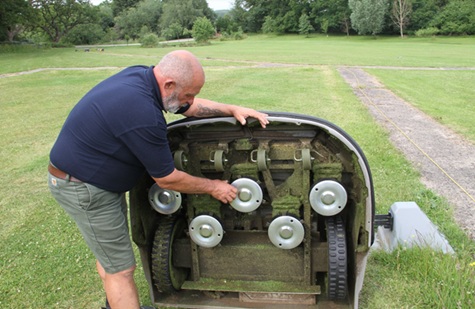
Users are notified via the phone app of any faults, stoppages or whether the robot has been tampered with. Safe mowing is guaranteed, even on slopes of up to 30%.
Like any piece of machinery or equipment the robots have maintenance requirements. It still early days but having spoken to both Gary and Jason and seen for myself the shear mount of work they are achieving, the robots are doing an excellent job, and the golfers are starting to recognise the value of the work they are doing.
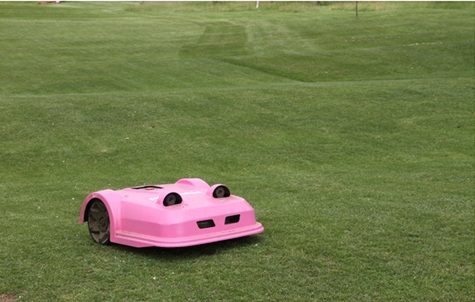
The club have named each robot. This came about when one of the club members unfortunately passed away and left some money to the club which was used to help purchase the robots. So to commemorate this person, they duly named the robot Audrey and painted it bright pink. A fitting gesture with many fondly remembering this person when they see Audrey the robot merrily working away.
I asked Gary, where do you see robot technology heading in the next few years? He told me, “The use of robotic devices is only going to grow massively over the next few years. We are generally seeing real improvements coming through in a few key areas. For a start, we’ll see more powerful robots – machines with proper full-sized rotary blades, not just the little ‘nibblers’ we’ve been used to. Battery capacity is another one. I think we’ll reach the point where robots can mow continuously for six or seven hours without stopping. And then there’s the software side, which is moving fast. We’re likely to see features like camera integration, Lidar, and much more sophisticated GPS and navigation systems, thus having the ability to tackle really complex terrains, and even precise cutting height adjustments built in.”
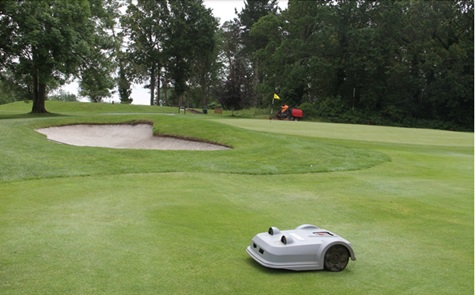
Personally, I was impressed in the manner the golf club had used robots and took them on board. As Jason said, they do take up some time to manage them, but the long-term gains are clear to see. He explained, “They are doing a great job. We ideally need a few more to fulfil our needs. Perhaps at least another five to cover break downs, charging times and achieve the mowing regimes required to present the course in its best light.”
From visiting Leamington Spa and other clubs around the country, I believe there is no denying that robotics are only going to get even more proficient and offer a plethora of job roles in the coming years.
Editorial Address:
LandPower Publications LLP, Howbery Park, Benson Lane, Wallingford, Oxfordshire, OX10 8BA
Telephone:
Steve Gibbs: +44 (0)7929 438213