How to resolve AdBlock issue?

Corrina Urquhart, executive officer at the Amenity Forum writes . . .
The amenity sector has an increasingly important story to tell.
Amenity management is often seen through quite a narrow lens. To some, it is about weed, pest and disease control. To others, it is about keeping public spaces tidy, safe and usable. But in reality, the sector sits at the intersection of public health, biodiversity, access, safety, regulation, professional competence, climate resilience and community expectations.
The way parks, sports surfaces, transport infrastructure, housing estates, public realm, industrial land and other amenity spaces are managed has consequences far beyond the immediate task in front of us. Decisions made on the ground affect people, wildlife, water, soil, budgets, risk, reputation and long-term sustainability.
This is why I believe Integrated Pest Management (IPM) is so important. IPM is sometimes talked about as if it is simply about reducing pesticide use or finding alternative products. That is part of the picture, but it is not the whole picture.
IPM asks us to understand the site, the pressures, the risks and the available options before deciding what responsible intervention looks like.
Why is a weed, pest or disease issue occurring in the first place? What are the site conditions? What level of intervention is actually needed? What can be prevented through design, maintenance, monitoring or cultural practice? What are the implications for public safety, access, biodiversity, costs and compliance? Where chemical intervention is required, how can it be used safely, proportionately and professionally?
Through my recent interactions with the Schumacher Institute, I have been reflecting more on how systems thinking can support practical decision-making in sectors such as amenity management. Sustainability is sometimes presented as a destination or a set of fixed answers. In practice, it is often about understanding relationships, consequences and trade-offs.
That perspective has stayed with me since I undertook applied research as part of my studies on permeable paving in car parks, exploring how drainage, surface management, environmental impact and long-term maintenance considerations interact. It reinforced how decisions in the built environment rarely sit in isolation and often involve balancing multiple, sometimes competing, outcomes.
The amenity sector does not operate in a simple environment. It has to balance public expectations for clean, safe, accessible and well-managed spaces with the need to protect biodiversity, reduce environmental risk, comply with regulation, maintain professional standards and work within real-world operational constraints.
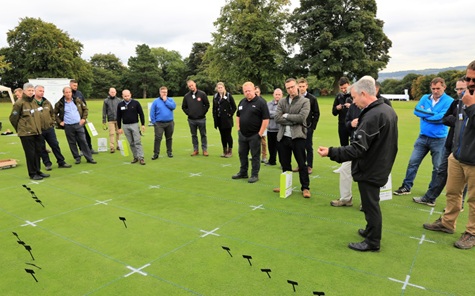
IPM is systems thinking made practical. It provides a framework for moving away from reactive, single-solution approaches and towards more informed, integrated and proportionate management. It recognises that prevention, monitoring, cultural control, physical methods, biological approaches, professional judgement and responsible product use all have a role to play.
It also recognises that good amenity management depends on people.
Contractors, grounds teams, greenkeepers, local authorities, manufacturers, advisers, clients, regulators and land managers all form part of the system. So do the public, whose understanding of amenity work is often shaped by what they see on the surface rather than the complexity of the decisions behind it.
That is where the Amenity Forum has an important role to play. The Forum is well placed to convene, inform and support the sector. It can help inform regulation and policy, translate policy into practice, share evidence-based approaches, promote professional standards and support a more confident public narrative about the value of responsible amenity management.
Responsible amenity management is not about choosing between productivity and sustainability, or between public safety and environmental care. It is about understanding the wider system and making informed, proportionate decisions within it.
A systems approach does not pretend those tensions are easy. It helps us navigate them more intelligently.
Editorial Address:
LandPower Publications LLP, Howbery Park, Benson Lane, Wallingford, Oxfordshire, OX10 8BA
Telephone:
Steve Gibbs: +44 (0)7929 438213